
From Recommendation to Purchase: Building AI-Ready Buying Experiences

Trade Hounds
This blog is the second in the series “From Product Data to Purchase: Designing AI-Ready Buying Paths for the Next Generation.” In this post, we’ll explore how AI is reshaping sourcing and purchasing—and how distributors and manufacturers can create more seamless buying experiences for both people and machines. You can read the first post here.
The next evolution of B2B buying is already taking shape. AI is moving beyond helping buyers research products and compare options—it is beginning to take action on their behalf. At the same time, many distributors and manufacturers are still relying on manual processes, handwritten material lists, and fragmented purchasing experiences that create unnecessary friction.
In the second part of our “From Product Data to Purchase: Designing AI-Ready Buying Paths for the Next Generation” series, we explore how AI is changing sourcing and purchasing. From agentic commerce and AI-assisted ordering to product availability and purchasing data, discover how distributors and manufacturers can make buying easier for both people and the AI systems increasingly acting on their behalf.
Agentic Commerce
Since ChatGPT first became mainstream three years ago, AI has mostly been used as a research tool. Buyers asked questions, compared options, and gathered information. But we are now entering the era of agentic commerce, where AI does not just answer questions. It takes action.
A major example came on September 8, 2026, when Meta launched Muse, a personal AI agent that can work across the web on a user’s behalf. It can fill out electronic forms, organize email inboxes, track price drops, book a flight, and support shopping. In roughly its first two weeks, Muse surpassed 2.5 million global downloads and overtook ChatGPT as the leading free iOS app in the United States.
Amazon notably blocked Muse from accessing its app and website. It is a bit ironic that Amazon helped reshape commerce by disintermediating traditional retailers and distributors. Now AI agents threaten to disintermediate Amazon. The company that disrupted the middleman now faces the possibility of becoming one.
But the bigger story is that consumers are beginning to hand multi-step tasks to AI instead of using it only to gather information. That should matter to every distributor and manufacturer in America.
Historically, digital experiences were designed for a human buyer who searched, clicked, compared products, and placed an order. Increasingly, parts of that workflow may be handled by software agents acting on the buyer’s behalf. Those agents still need accurate product data, availability, compatibility information, substitutions, specifications, pricing, and inventory. The companies that make it easiest for both humans and machines to complete a transaction will have an advantage.
A strong buying path answers the next question before the buyer has to ask it: What replaces a discontinued item? Which accessory is required? Which products are compatible? Which configuration fits the application?
We spent the last twenty years optimizing websites for people. The next decade may require us to optimize buying paths for both people and AI agents.
This also changes what marketers should measure. “How much traffic did AI send us?” is becoming the wrong question because, in an agent-assisted purchase, there may be no website visit to count. The questions that will matter are:
-
How often were we recommended?
-
How often did we make the shortlist?
-
How often did an agent choose us?
Companies should start asking those questions now, while agent-driven volumes are still small enough to examine individual journeys and learn what influenced the decision.
Reduce Manual Data Entry Errors With AI
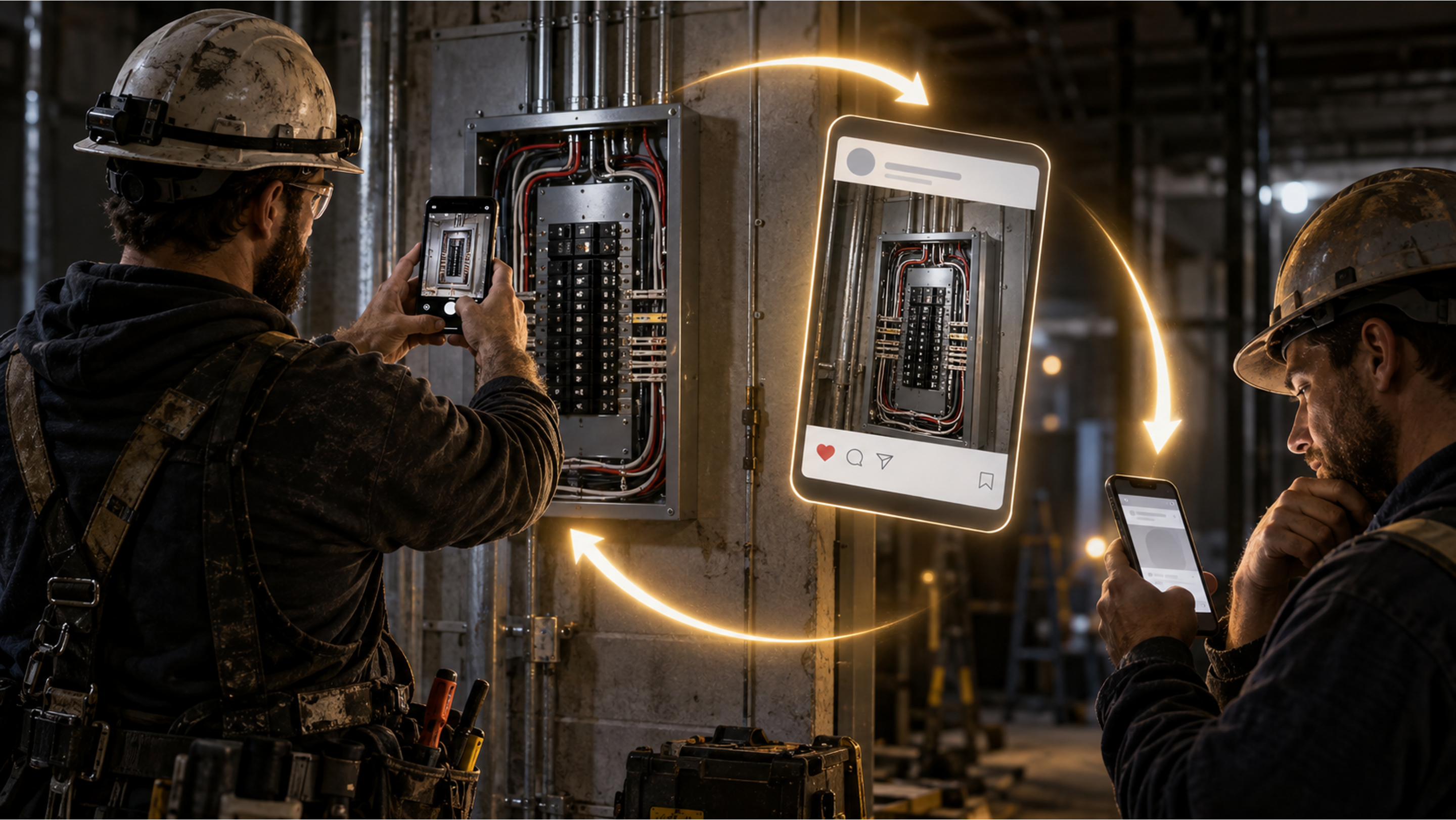
While some customers are getting excited about agentic purchasing, many are still scribbling their orders on a piece of cardboard in the field and sending it to sales reps. Nearly 90% of distributors we surveyed receive handwritten material lists at least monthly, and more than two-thirds receive them at least weekly. Not only is this time-consuming, but it also leads to manual data entry errors. AI can help streamline purchasing for both the buyer and the seller. For example, in Trade Hounds, we built an AI tool that can read handwritten lists and convert them to a bill of materials linked to a distributor’s product catalog data.
This is a free tool for contractors to reduce friction from digital material ordering. We’re seeing digital commerce increase in our industry, but friction is still a big issue costing both buyers and sellers time and money at the purchasing stage of the buyer journey.
Seven out of 10 Trade Hounds users visit supply houses at least once a week, but fewer than one out of 10 describe distributor websites or app experience as great. 54% of respondents to a B2B Pulse Survey even said they’d switch suppliers if they don’t have a smooth omnichannel experience. As digital commerce grows, AI can be a great tool to improve the purchasing experience.
When you help your customers save time, not only are you improving your relationship by removing friction, you’re freeing them up to do the work. That time adds up to more jobs and more materials they can purchase from you.
Which factors matter most for buyers during purchasing
AI can also help distributors analyze purchasing data to improve share of wallet. Distributors now have more data than they know what to do with. The trick is understanding what the data is telling you. We use AI to analyze purchasing data for trends that can uncover win-win opportunities for distributors to better serve their buyers and, in turn, make more money.
We conducted a survey of more than 200 electrical contractors and distributors. Buyers ranked availability as the most important purchasing factor, while sellers believed price was the primary driver.
For many electrical contractors, the cost of a delayed crew often exceeds the savings from negotiating a slightly lower material price. Electrical contractors make money by keeping crews productive. If material is unavailable, electricians wait. Foremen wait. Equipment sits idle. Other trades may be delayed. Schedules slip. Idle labor, extended labor costs, equipment costs, and extended field overhead are major sources of project losses when work is delayed.
That’s why availability and supplier reliability occupy two of the top three positions in the contractor survey. Yet 57% of distributors override system pricing often or always, 87% override it at least sometimes, and less than 2% say they never override it. When asked what would most improve quote win rate, 67% guessed pricing and only 35% said availability.
That means distributors are unnecessarily undercutting themselves while failing to adjust to meet what buyers actually need. Distributors can be making a lot more money if they stop cutting their pricing and instead analyze their data to identify where inventory needs to meet demand.
Buyers want confidence that material will be available when they need it. So we recommend distributors focus on increasing transparency and decreasing the time it takes for buyers to find product availability online or in apps. And to help distributors make better decisions about their pricing and quoting performance, we’re excited to be adding this type of data to the Trade Hounds Pro seller portal.
Final Thoughts
AI-powered purchasing does not have to mean completely replacing the way buyers order today. The opportunity is to remove the friction that slows buyers down—whether that means helping an AI agent identify the right product, turning a handwritten material list into a bill of materials, making inventory availability easier to find, or using purchasing data to better understand what customers actually value.
The future of B2B purchasing will depend on how easily buyers can move from product consideration to confident purchase. That requires accurate product data, accessible availability information, seamless digital experiences, and AI that can turn complex purchasing data into useful decisions.
As AI takes on more of the work involved in sourcing and purchasing, distributors and manufacturers have an opportunity to build buying experiences that work for both humans and machines.
Subscribe Here!
