

Siemens on Workforce Development and Value-Based Selling in Construction

Trade Hounds
The construction and electrical industries are changing faster than ever. With an aging workforce, a new generation entering the trades, and the rise of AI and digital tools, companies must rethink how they attract talent, train employees, and deliver real value to customers.
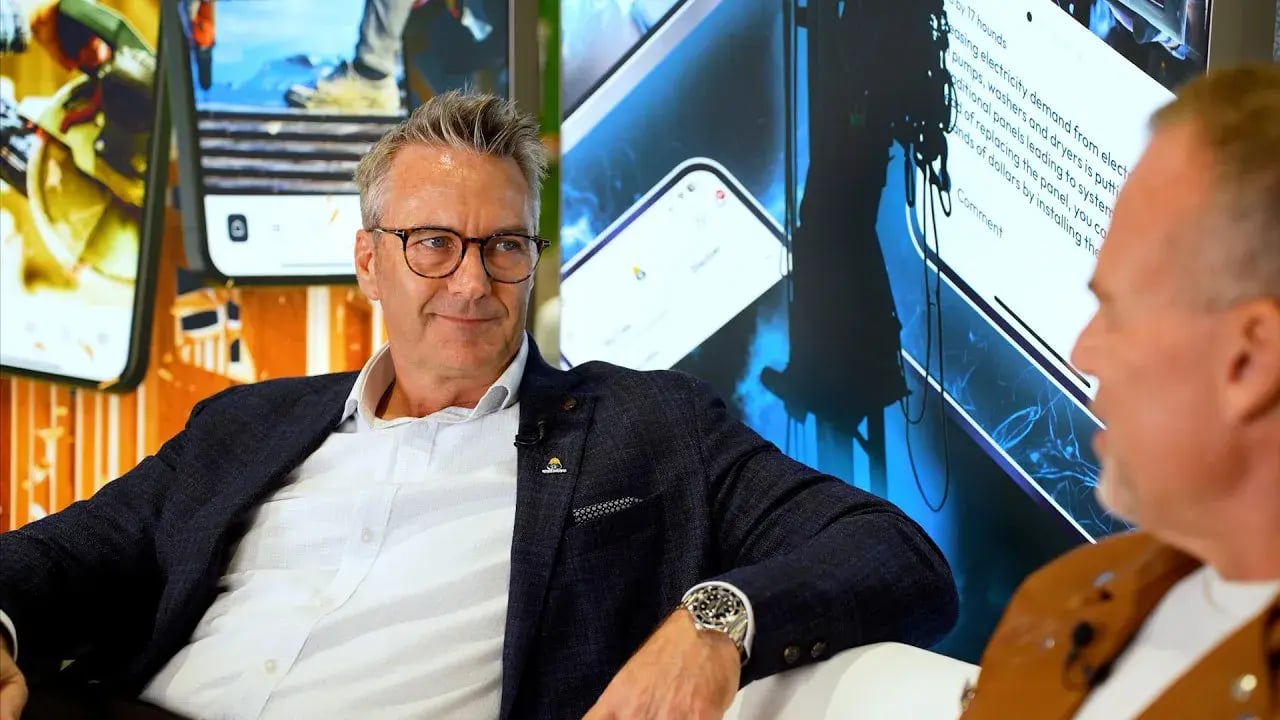
At NECA 2025, Trade Hounds CEO David Bauders sat down with Steve Maughan, Siemens’ VP & Head of Electrical Infrastructure Sales at Siemens, to explore how the company is tackling these challenges. From innovative workforce programs to shifting sales strategies, Maughan shares what it takes to build a future-ready workforce while staying ahead in a competitive, technology-driven market.
We’re here at NECA 2025—what are you seeing and hearing so far? What’s new and exciting at the show?
The technology, obviously, is what stands out. Walking around the booths, you get to network, meet a lot of old friends, and make some new ones, which is why we're here as well.
We've also had a couple of good sidebar meetings and some interesting topics of conversation, all kind of coming back around to how the industry has really changed over, I would say, post-pandemic.
Can you expand on how COVID-19 has reshaped the construction and electrical industries?
I think I always refer to it as pre- and post-pandemic because I think it is such a stark difference. In fact, in the meeting we had earlier, we met with a number of large contractors—almost like a council meeting. One of the key comments was that this industry, the construction industry we play in, hasn't really changed in decades.
Yet post-pandemic, with the digital revolution, people having to work from home, and having to relearn skills and adapt to new technologies, it’s really changed the way we go after the market.
Another key thing that I think everybody's somewhat struggling with—and that you guys help tremendously with—is workforce development. Bringing people together, figuring out how to catch up on the years of—I wouldn't say neglect, but inattention. We’ve got an aging workforce that everybody's talking about, and we've kind of known it for a long time. I remember being in meetings back in 2012 when we were talking about this bubble that was coming toward us. So I think we've had time to deal with it, but the pandemic really accelerated it.
With up to half of the electrical workforce expected to retire over the next decade, how important is it to connect with the next generation entering the trades?
Talking to our customers, our partners, everybody's in the same boat—the trades, the contractors, the GCs, even the end users—they're struggling with the same dynamic: how do you find talent? How do you bring new talent into the industry?
From my personal experience, I think once you crack the code to some extent, the talent is incredible. The younger generation—I'm going to call them early career professionals coming out of college—they've been brought up in a completely different world than I had. Absolutely. So they behave differently. That doesn't mean they're any less capable. In fact, they can be a lot more capable in certain areas.
I think it's all about how you connect with them, how you understand what motivates them, what drives them, and how they learn. I was an apprentice. I left school at 16 and did a four-year apprenticeship. I went out into the workplace, horrified and petrified of all these 50- and 60-year-olds picking on the 16-year-old who knew nothing. It's kind of the same, but different, if you understand what I mean.
We are doing a lot of different things to attract talented individuals into our organization—people who've got aspirations and a passion for what we do, even if they don't really know what we do.
At the same time, we're helping our partners with Educate America, providing tools, platforms, and systems to assist in bringing on, training, and educating their employees—the employees of the future, and things like that.
The other side—the kind of third leg to that stool for me—is people like yourselves. That's the part where you're trying to connect and meet people where they're at. You know that better than I do, but in my simple brain, they want information in a different way. They want to find it in their own space, and we've got to go meet them there.
Many younger professionals prefer peer-to-peer content over manufacturer-provided material. How do you see that impacting communication and education in the trades?
That's so true. Even I don't want it, but I like to see the new content that's coming out—whether it's TikTok, YouTube, or you guys. The difference between what a manufacturer is going to produce—and I think we're aware of it, but we can't help ourselves—is that we're always going to focus on the technology rather than who we're trying to educate.
I think the difference with Trade Hounds and what you guys do is that you've actually created a community of like-minded individuals who can feed off each other, if I understand it correctly. From what I've seen and read, and from some of the output on that platform, it's kind of mind-blowing and makes us rethink how we communicate.
Can you explain Siemens’ approach to workforce development, especially in terms of training new employees and keeping them engaged?
One of the big learning curves for us over recent years was actually that we created a development program. What we do is, when we hire graduates from different backgrounds, they're not necessarily engineers. You can teach them technology, some of the softer skills, communication skills, and things like that. You want to hire that kind of talent if you can and encourage it.
We were graduating people through our training program who were somewhat prepared for the outside world. It's back to that 16-year-old who went out and did a four-year apprenticeship—thought he knew everything, but knew nothing.
What we used to do was send them all over the country to different assignments once they graduated. Now, what we do is keep them in a hub in Atlanta. You might say, well, there's nothing rocket science about that, but it gives them more time to mature, more time to get exposure to the technologies, product experts, and experienced people around them—but more importantly, the social environment.
If we send them out into the field, into the world, they're going to be working from an apartment somewhere on their own, isolated. No culture, no development, no like-mindedness.
Creating the hub and keeping them there typically keeps them for about a year or two, and then they drift off into their different assignments. But by then, they're so much more mature, so much more ready. That was a big learning curve for us.
How is Siemens attracting top talent on the sales side, given the demographic shifts in the industry?
It's interesting because we do Power U, which is Power University. It's an in-house, week-long training class we do every two years. The last one we went to was kind of mind-blowing because we looked out at five to six hundred people in the audience, and the demographic was markedly different from what it would have been five years earlier. Youth, backgrounds, ethnicities, cultures—a massive shift in just three to five years.
That was good to see, but you've got to be very aware of how people want to interact, how they can learn, and what they want out of their career. You've got to accommodate for that somehow.
As AI and digital tools automate routine tasks, how is Siemens shifting its sales team toward more value-based selling?
That's a great and timely question because, again, going back to the shift, we are finding that we are leveraging technology to support our channel much better. Exactly what you said—AI, online content, partnering ecosystems, digital platforms.
We've got to try and do that because our business is growing so quickly. We've got to take our Siemens-qualified sellers and get them higher up the food chain. We're doing that through training in account management.
If you think about the way our salesforce worked traditionally versus what true account management is, it's black and white—they're not the same skillset, very different. Like you said, it's more of a solutions, consultative type of selling, which is very different from the court-based selling they would traditionally do. It involves business acumen, understanding your customer, their dynamics, and what they need.
How do you train your managers to become effective coaches and “force multipliers” for the sales organization?
The challenge we’re all faced with is getting businesses moving at such a high speed that managers can very quickly get sucked into the day-to-day grind—being the superstar closer, the expediter, the one who knows.
Going back to your original point, we’ve probably turned over 30% of the sales organization, with new sellers coming into the market. They don’t have the experience, so there’s a lot more handholding, a lot more coaching, developing, and on-the-job nurturing of talent. As a result, managers get pulled into that too.
We’re doing training around strategic thought and strategic management. We’ve spent a lot of time on coaching because, typically in our industry, our managers come from the floor. They are salespeople or engineers or something like that. They’re not natural coaches.
So we’ve invested significant time in developing their coaching skills so they can be that nurturing and coaching influence as well.
How is Siemens leveraging sales analytics to help frontline sellers add value for customers and drive business growth?
We’re using AI more and more to analyze opportunity prospects and the likelihood of a successful opportunity—account planning and things like that. We’re also moving into the world of AI agents. So if you’re an account manager responsible for an account, you’ve got a personal assistant there gathering intelligence—think ChatGPT for you and your customer. It’s constantly looking at your email trail, your pipeline, your relationship mapping, and building a picture. Then it’ll come back and recommend things. It might say, “Hey, you might find this useful,” or “You’re going to talk to so-and-so about X. Here are their interests.” It will link their business drivers to our business drivers and even make pitch recommendations.
Now, it’s in its infancy. I wouldn’t say we’ve cracked the code, but I get excited about it. I really do. I come from a technology background on the automation side, so when I get into that digital world, it fires me up.
When I see what we can do to drive productivity and efficiencies and leverage AI for the benefit of everybody, it’s exciting.
How does Siemens create value for customers and shareholders?
I think value is created at the front end. Ideologically, that’s where we want to be, and that’s where we’ve been trying to take our sales organization for the last three years—to get closer to the end customer through the value chain and get in early so we can genuinely be a technology partner to our customer and help them be more successful.
The last thing you want is to be where we were five or ten years ago, where it’s three bids and a buy on a spec job. That’s massively shifted. If it comes down to negotiations and you are one of three or four options, and you haven’t made a value proposition that resonates and differentiates—so you have a real point of difference—then it’s a tough negotiation. It becomes a race to the bottom.
So it’s all about trying to get in earlier in the cycle and making sure we can genuinely add value and create a point of difference that people recognize. If we do that, I’m not saying the margins are through the roof, but it puts us in a much better position because we’re not just bringing a product to market. We’re bringing expertise, knowledge, partnership—opening doors they may have never even thought of in the past.
Final Thoughts
The electrical and construction industries are evolving rapidly, and success now depends on more than technology alone. Companies that invest in workforce development, understand how the next generation learns and engages, and leverage AI and digital tools to improve productivity and customer outcomes will be best positioned to thrive. Siemens’ approach demonstrates that strategic training, mentorship, and value-based selling are key to building a resilient, future-ready workforce.
Want to dive deeper?
Watch the full conversation below to hear more insights on developing talent, embracing technology, and creating real value for customers and partners.
About Trade Hounds
Trade Hounds is America’s largest and most engaged community built exclusively for skilled tradespeople. With hundreds of thousands of users across construction, electrical, plumbing, HVAC, welding, and more, the platform helps workers showcase their skills, share jobsite insights, connect with employers, and access critical resources that support their careers. Trade Hounds is committed to elevating and empowering the trades workforce through technology, community, and opportunity.